Screver: AI Voice of
Customer Platform.
2020–2024, 2026
UI Designer → Team Lead
Screver is an AI-powered Voice of Customer platform that helps companies collect feedback, understand complex customer signals, and turn them into actionable insights. The platform brings together survey creation, omnichannel feedback, AI-powered analysis, dashboards, automation, and integrations in one system.
THE CHALLENGE
Screver brings together several complex workflows in one product: creating surveys, managing feedback campaigns, analysing large amounts of data, configuring automation, and turning insights into actions.
The main design challenge was making this powerful functionality understandable without oversimplifying it.
Users range from people creating a simple survey to enterprise teams managing multiple markets, data sources, integrations, and compliance-sensitive workflows. The interface had to support both without making everyday tasks feel unnecessarily complex.
MY ROLE
I was the sole product designer responsible for the UX and UI of the Screver platform.
I worked across the complete product experience, from early concepts and information architecture to detailed interaction design, prototypes, design system components, and developer-ready specifications.
My work covered both new features and the continuous evolution of existing workflows as the product grew.
LEARNING FROM OUR USERS
Screver served very different types of users, from occasional survey creators to enterprise teams managing complex feedback programmes across multiple markets.
Their needs often conflicted: occasional users needed simple, guided workflows, while advanced users needed flexibility, automation, permissions, and deeper configuration. This shaped many of my decisions around progressive disclosure, reusable patterns, and role-specific experiences.
A large part of the work was turning highly configurable functionality into workflows that still felt predictable.
Instead of exposing every option at once, I structured interfaces around progressive disclosure, clear hierarchy, contextual controls, and reusable interaction patterns.
This made advanced functionality accessible when needed while keeping the main user journey relatively lightweight.
SURVEY CREATION
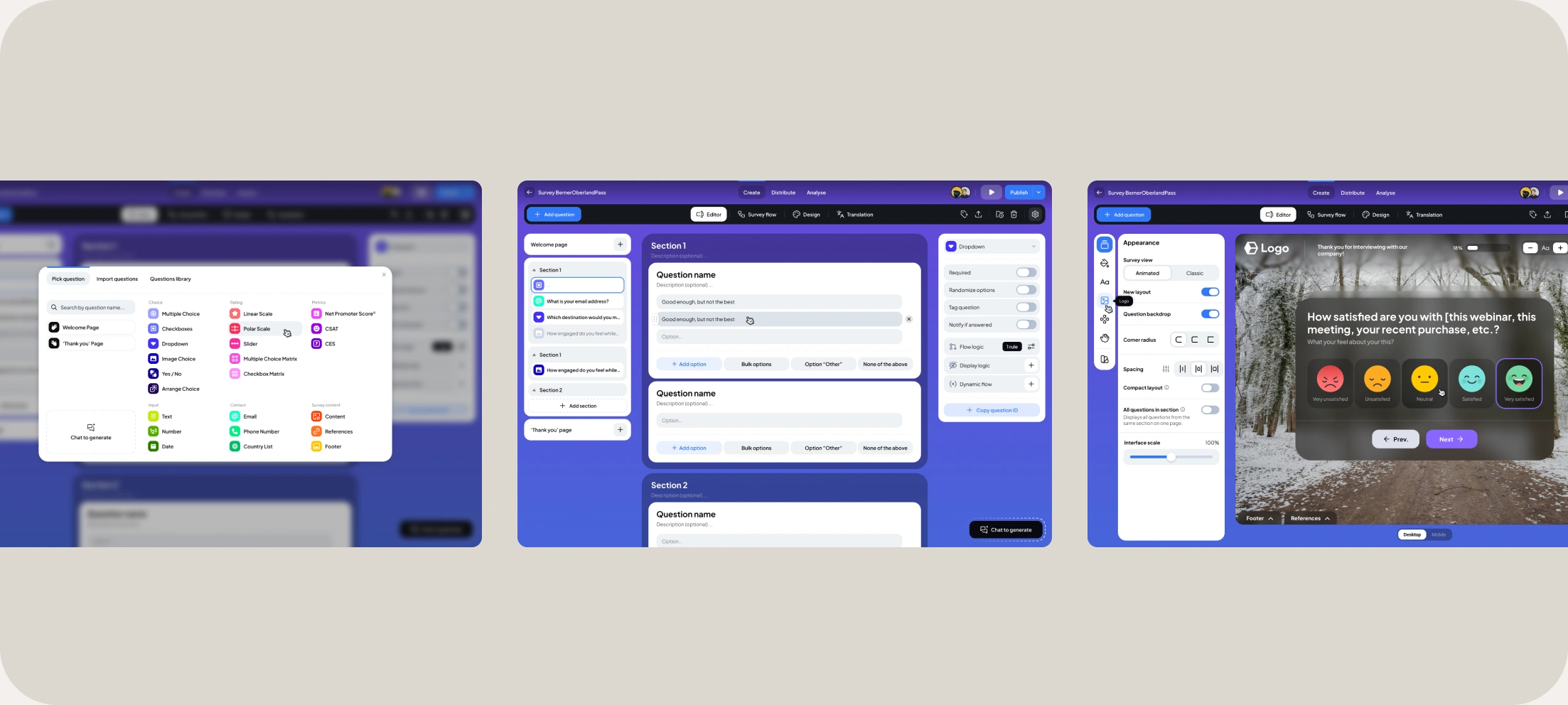
One of the core experiences was the survey builder.
Users needed to create anything from simple feedback forms to more advanced surveys with different question types, branching logic, scoring, custom styling, and reusable settings.
I designed the creation flow around a modular structure so users could quickly build and edit surveys while always understanding where they were in the process.
The same system needed to remain flexible enough to support new question types and configuration options as the product evolved.
ANALYTICS & INSIGHTS
Screver turns feedback from surveys and other customer signals into dashboards and actionable insights. The platform supports role-specific views so different teams can focus on the information relevant to them.
My work focused on making dense data easier to scan and interpret through clear information hierarchy, consistent visual patterns, filtering, comparisons, and drill-down interactions.
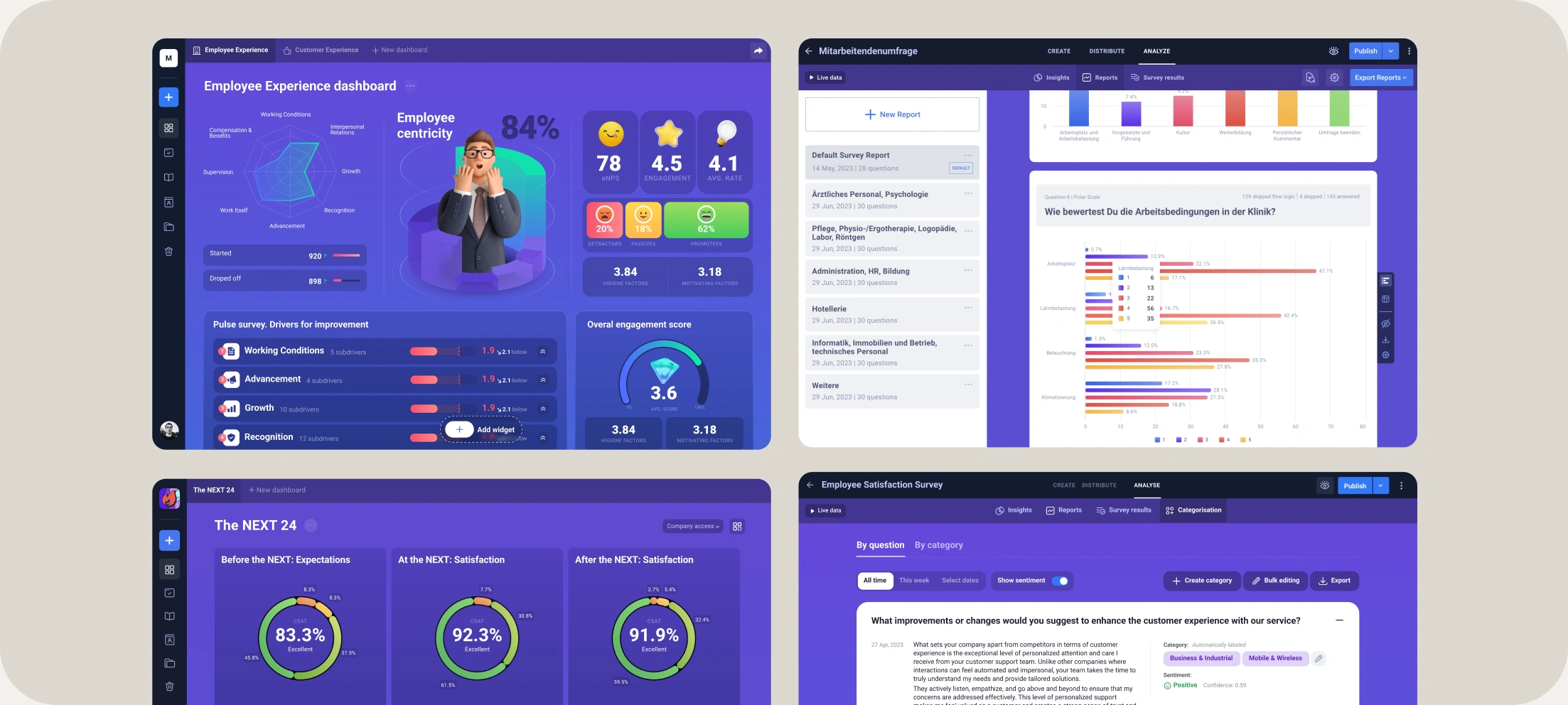
The goal was not simply to display more data, but to help users understand what required attention and what they could do next.
AI & AUTOMATION
As AI became a larger part of the product, I designed experiences where AI could analyse feedback, identify patterns, summarise information, and support automated workflows.
Screver currently uses AI agents for use cases such as detecting trends, summarising surveys, identifying negative feedback, and routing important signals to the relevant teams.
The design challenge was making AI functionality feel transparent and controllable rather than turning it into a mysterious black box.
I focused on clear inputs, understandable outputs, visible system states, and giving users enough context to confidently act on AI-generated insights.
BUILDING A SYSTEM, NOT INDIVIDUAL SCREENS
Because I was designing the complete platform, consistency became increasingly important as the product expanded. I created and maintained a reusable design system covering navigation, forms, tables, cards, filters, charts, modals, drawers, feedback states, and other recurring patterns.
This allowed new functionality to be designed faster while keeping interactions familiar across different parts of the platform.
It also reduced one-off solutions and made collaboration with development significantly more efficient.
The goal was not simply to display more data, but to help users understand what required attention and what they could do next.
LEARNING FROM REAL USE
Many product decisions came from working closely with the Screver team and reviewing how customers used the platform in real scenarios.
Enterprise clients often introduced workflows and edge cases that were difficult to anticipate from idealised user journeys alone.
I used this feedback to simplify confusing interactions, improve terminology and hierarchy, and evolve existing components instead of continuously adding new UI patterns.
HOW I USED AI
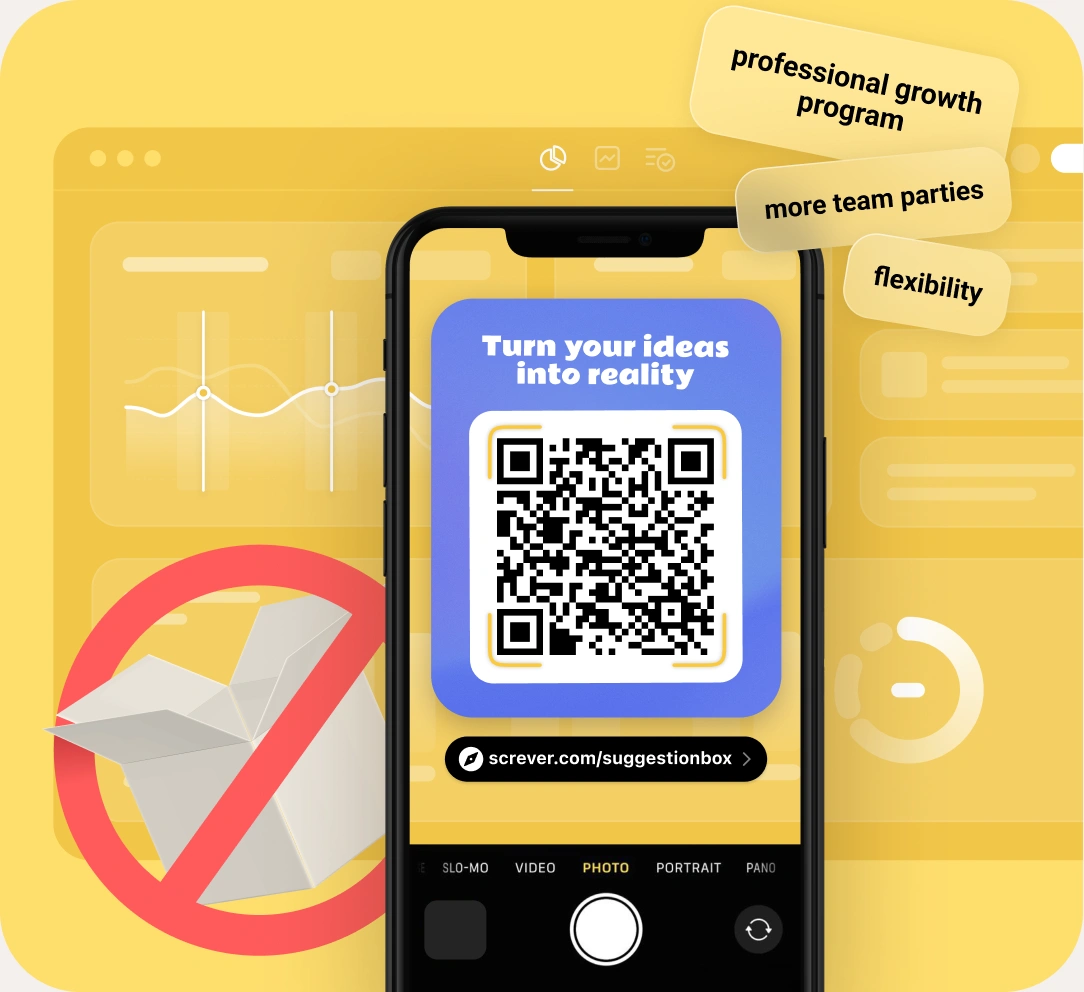
AI became useful both inside the product and as part of my design workflow.
I used it to explore alternative UX approaches, structure complex requirements, generate and refine microcopy, analyse edge cases, and speed up repetitive parts of product work.
It did not replace product decisions. The final structure, interaction patterns, priorities, and visual solutions were based on product context, user behaviour, technical constraints, and collaboration with the team.
THE RESULT
Over several years, Screver grew from a feedback and survey product into a broader AI-powered Voice of Customer platform supporting complex enterprise workflows.
My work helped create a consistent product experience across that growth, allowing new capabilities to be added without rebuilding the interface from scratch.
Designing the platform end to end also gave me experience with something I value particularly highly: not just designing individual features, but shaping how an entire product behaves as a system.